The Analog Session is a music project conceived in February 2009 by Maurizio Dami (aka Alexander Robotnick) and Lapo Lombardi aka Ludus Pinsky.
Initially conceived as a video project (currently with over 120,000 hits on Youtube), The Analog Session then became an album and finally a live performance. For Alexander Robotnick and Ludus Pinsky it’s not about being nostalgic for an era they represented but is more a progression and improvisation in the present music scene currently dominated by computers.
Italian electronic pioneers, Alexander Robotnick and Ludus Pinsky deliver their second album as The Analog Session. ‘Black Ground’ is a journey into electronic music, from the early 70s to modern techno, performed only with vintage analogue synths.
Wires, cables, knobs, keyboards: they are still a vital part of The Analog Session’s improvised world. But as opposed to 2013’s “April” album, “Black Ground” is more dance orientated in its vision. Although most of the tracks originate from improvisation, there¿s more editing work on their individual parts so that they sound more structured and danceable than usual.
The new album tracks range from electro-disco to techno, opening up to melody and chord arrangements
throughout. “My Dream” for instance is an introspective theme that is developed throughdifferent arrangements,
alternating with an almost electro-house rhythm. “Lonely Dancers” is made up by a sequence of synth notes whose sound transforms and becomes the backbone of a track that could be perhaps be seen as `minimal-electro whilst “We Are Here” has a style that’s more difficult to define. As in “My Dream”, here too a dream-like theme
disrupts the minimal atmosphere that provides the tracks structure.
“Space Circle” is built on an harmonic progression of four chords, repeated throughout the track whilst undergoing. continuous variations – inversions and substitutions – where the tone-colour of the analog synths fully capture the alternating soundscape. “Shure I Like” injects an element of 80s synth pop with its infectious melody providing a link to the duos long-estbalished past but “Wild Electrons” takes us further into future-space as the duo explore the sound potential of the latest (polyphonic) synth assembled by Ludus Pinsky.
Finally “Black Ground”, the title track, brings us back to planet Earth where the analog sound reveals its concrete, earthly nature. The CD also includes two previously digital only remixes: “Ascension” (Late Night Rmx) and “Effai” (Late Night Rmx).

Remixes 2
1) N5 From Outer Space (summer rmx)
2) Funfare (summer rmx)
Hot Elephant Music
Release date: September 2, 2013
Alexander Robotnick and Ludus Pinsky remix two of the band’s best known tracks:
1) N5 From Outer Space (150.000 views on Youtube)
2) Funfare (115.000 views on Youtube)
The 2 tracks were included in the box (CD-DVD) released
in 2010 by This is Music Ltd.
N.5 From Outer Space is slowed down from 128 BPM to 121 BPM to match the present trend in Techno, while Funfare remains in its original 124 BPM.
Remixed in a dance-oriented mood they still preserve the improvisation feeling that characterizes the band. All sounds are strictly analogue.
The Analog Session – REMIXES 2 by Alexander Robotnick
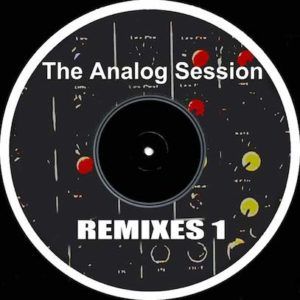
Remixes
1) Effai (Late night RMX)
2) Ascension (Late night RMX)
In “Effai(Late Night RMX)” and “Ascension (Late Night RMX)”Alexander Robotnick & Ludus Pinsky re-interpret in Tech-house style the material recorded in the improvisation sessions that led to the making of the album. The result is a powerful groove, minimal but extremely warm because it’s analog and made more pouncing to hit the dance-floor.
This new release by The Analog Session is another step into the artists’ exploration of analogue electronics of the 70s and early 80s proving that analogue sounds indeed better not only in “space music” but also in contemporary techno .
The Analog Session : Effai – Ascension (late night rmx) cuts by The Analog Session

APRIL
INFO-PLAYLIST
1) Ascension (127 bpm)
2) Effai (128 bpm)
3) Strange Fruits (127 bpm)
4) April (120 bpm)
5) Amigos (126 bpm)
6) New Mandarins (132 bpm)
7) Little Grunge (140 bpm)
8) Distant Voices (124 bpm)
Produced and composed by Alexander Robotnick & Ludus Pinsky
Mixed & mastered by Tommaso Bianchi
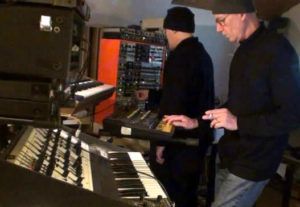 Alexander Robotnick and Ludus Pinsky deliver their album ‘April’ as The Analog Session. A journey into electronic music, from the early 70s to modern techno, performed only with vintage analogue synths.
For many club based electronic music concerts (with the exception of academic or experimental concerts) essentially consist of a couple of artists, usually DJs, fiddling on their laptops, rhythmically nodding their heads along for the duration of the “concert”.
“We don’t know whether such a situation may be called ’live’ but to us a concert is something different. As we are talking about electronic music, obviously most of the music played is ‘sequenced’. This however does not prevent the artist from interacting with it by physically playing different parts and improvising.”
The Analog Session’s natural vocation is the live performance and it was indeed conceived as a live improvisation of electronic music. What The Analog Session bring you is a real ‘vintage synth’ experience with a unique sound that cannot be imitated by any other instruments. Every time they perform live they create a different sound environment all based on interaction with sequences of written notes, modifying their timbre and dynamics whilst playing ad-libed flourishes on keyboard synthesizers as a jazz player would.
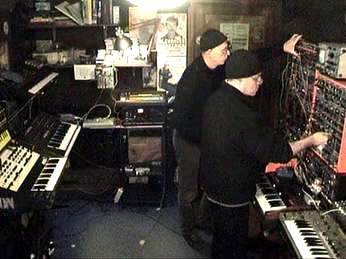 “We decided to use vintage synths, mainly dating back to the 70s. Their sound is still unique and cannot be imitated by hybrid synths or by digital synths and even less so by software synths. Such ‘vintage synths’ are still used at many professional studios by electronic music producers; but it is quite rare to see them on stage because of the many technical problems they present: they are very fragile, unstable in tuning and most of all it is impossible to record the timbre and recall it at each track.”
This was the spirit of early synth pop music back in the 70s of which both Alexander Robotnick and Ludus Pinsky have vivid memories from their first entry into the world of electronic music. However, the project does not intend to imitate such bands as Tangerine Dream. Forty years have passed, techno music evolved considerably and both protagonists have been developing long artistic careers gaining vast know-how and skills. It is not so much the 70s music they wish to retrieve but rather its “progressive” spirit as well as the ability to improvise, which has become more and more marginalised in the present music scene dominated by computers.
The new album tracks range from electro-disco to techno, opening up to melody and chord arrangements throughout. From the opening, rolling funk of ‘Ascension’ to the electro shimmer of ‘Effai’ and the tougher edged groove of ‘New Mandarins’ The Analog Session show us there’s still new life left in those old machines.
The Analog Session in action
The concert lasts from 1 to 2 hours. The Analog Session can be performed in clubs but needs some time and space to set up its equipment which consists of 2 modular synths – which are the core of the system – 5 more synths with keyboards and some vintage effects including a tape echo.
Tracks range from electro-disco to techno. It is therefore dance music but never repetitive and opening up to melody.
The Analog Session can only be performed at venues that can be reached by road from Florence because its equipment cannot travel by air.
The Analog Session – New allbum special mix by The Analog Session
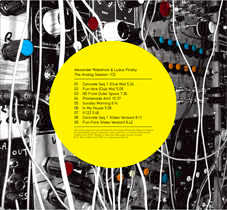 This is Music LTD
Alexander Robotnick VS Ludus Pinsky :
The Analog Session
CD/DVD – Buy this album at DiscoGS
Concrete Seq 1 (Club Mix) – 5′ 24″
Fun-Fare (Club Mix) – 5′ 09″
N5 From Outer Space – 7′ 36″
Promenade Am3 – 10′ 37″
Sunday Morning – 6′ 14″
In My House – 5′ 58″
It.122 – 5′ 46″
Concrete Seq 1 (video version) – 8′ 11″
Fun-Fare (video version)” – 6′ 42
HISTORY
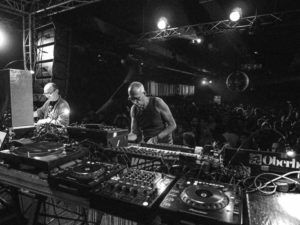 In February 2009, Alexander Robotnick and Ludus Pinsky put together their personal analog synths to organise and perform an Analog Session.
The idea was to recreate the purely analog sound of the 70s and early 80s, which the two artists consider being the true “electronic sound”.
The Session lasted 5 days , 3 of which to set up and connect pieces of equipment and to fix sync problems and VAM malfunctioning.
TRACKS
7 tracks were recorded, mainly developed on improvisation.
There were 2 and sometimes 3 sequencer lines written in Midi driving 3 Midi/Cugate convertors.
Improvisation consisted in controlling the sound of the synths and playing Logan , Wasp, and JX3P.
VIDEO
The entire session was recorded in real-time by two cam-coders so that every sound event is documented by the video.
RECORDING
The session was recorded on 10 audio channels
EDITING
Being all tracks mainly based on improvisation, the artists didn’t pay much attention to the their individual duration .
In the end the sessions selected for every track were more than 15 minutes long each. The less significant parts were therefore cut out both from the audio session and its video recording so that the video was still in real-time.
The video was shot by 2 static cameras ; a few shots of individual pieces of equipemnt were added in the editing but it’s essentially the real-time recording of the Analog Session.
MIXING
Tracks were mainly processed by analog outboards , such as tape-echo and vintage effect boxes.
No further track was added to the originals recorded.
INTERVIEW (January 2010) – LAPO (Ludus Pinsky)
This is a modular with 1970s technology. These are the original of a project of the mid70s by a magazine called “Electro Formant” that I restored and assembled. And these are chlone filters. This is a Moog chlone , this is a Polimoox chlone, which is a Russian filter, this is an MS 20 chlone etc. etc.
Then there’s another Formant oscillator, the original one and several Formant envelope chlones. VCA is also a chlone. Then there are these ring modulators, this one in particular is really old technology, it’s a passive coil ring modulator .
This is a sequencer that I assembled. It’s a mix including a TB303 slide. It has 8 steps that can extended to 16 , and 4 lines.
Then there’s this controller, made of 4 ribbons to control the voltage of whatever you need. There’s an LFO and a Joystick taken from an old Yamaha controller.
Ant this is the good old Logan from the 70s.
It’s all technology developed before 1980 because apparently in the late 70s a law was passed that banned the use of several metals, such as lead, in manufacturing transistors, and indeed all synths manufactured after the law do not sound exactly like those made before . Only experts and real lovers of that sound know and understand .
Maurizio (Alexander Robotnick)
This is a mix of the things I used in the 80s and stuff that I acquired more recently.
I recently bought this biphonic Oberheim from the late 70s. , the famous SEM.
Then I got this WASP from a friend , which I used also in the early 80s.
This is Korg Mono-Poly , an instrument I’ve always used , also to compose “Problèmes d’Amour” as well as A.Robotnick’s early works.
Here we have – kind of hiding in here – a classic Roland TB 303, which does its job in this session with the typical TR 808.
Here below we have a Korg Stage Echo that I’m using to transform the sound of the WASP and the resulting effect is really great.
Maurizio & Lapo:
Hi, I’m Alexander Robotnick and he’s Ludus Pinsky, my faithful pal in elechtro-madness and a true elechtronics wizard: he succeeded in restoring and assembling several analog synths, very difficult to handle, and so we decided together to do this purely analog session… different kinds of tracks, from house to techno. The common denominator of these tracks is that they make no concession whatsoever to present time digital sound . For that purpose we used the modular that you can see at our back – which Ludus assembled with a lot of patience and self-denial – and some old synths that I used in the early 80s.The characteristic of this session lies in its sound which is closer to the 70s’ mood than the 80s’.
Of course the 70s mean both good and bad. We immediately realised the negative side when we started to put together all this stuff because after three days we were still struggling with technical problems of all sorts. First of all the cabling itself: we went down to the basement to dig out hundreds of cables to connect and interface everything. And then each instrument presented some problems; we had to tackle some quite difficult technical problems.
But finally we made it , we managed to produce sounds first and the music we composed was essentially just some notes, because the main feature of elechtronic music of the 70s was improvisation, so we didn’t write down every sequence on the computer, some sequences were written directly on the instruments.Then of course there’s also a laptop with some MIDI sequences, not many though; these MIDI sequences were then transformed into CV and GATE to pilot analog synthetisers. On top of that we transformed MIDI-Sync into an old Sync, an analog signal that allowed us to play also TB 303 and 808 sync.
We used a recorded audio trigger by which we controlled the sequencer of the modular you can see at our back.
You may like this session or not, it’s up to you; we had fun and trouble as well but we believe it was worthwhile. I don’t know whether we’ll repeat this experience in the near future. But we wish to encourage others to repeat it because the “softness” of the elechtro-sound of the 70s certainly pays you back for the hard work done.
Enjoy it!